High gloss has re-emerged as a defining material in contemporary kitchen design, moving beyond decoration to actively shape light, expand space, and influence how a room is experienced. Across five distinct kitchens, from subtle architectural ceilings to fully immersive, color-drenched spaces, the approach varies, but the idea remains consistent: when used well, high gloss does not just reflect a space, it transforms it.
.jpg)
"High gloss is not simply a finish - it is a philosophy. A decision to let a surface do more than sit quietly, to instead actively participate in the architecture of light around it."
The kitchen has always been the room where material decisions are most scrutinised - where durability, practicality, and beauty must coexist under the same roof. In 2026, one finish is winning that argument with extraordinary force: high gloss. Across ceilings, cabinetry, floors, and even islands, the lacquered, light-hungry surface has become the defining material signature of the most considered kitchens being built today.
The pursuit of reflective surfaces is as old as the pursuit of beauty itself. Long before lacquer became a kitchen finish, it was an art form - the Chinese and Japanese lacquer traditions, stretching back over three thousand years, produced objects of extraordinary luminosity by building up dozens of layers of resin, each one burnished to a mirror sheen. These objects were so prized in 18th-century Europe that the style of imitating them - japanning - became a fashionable obsession, appearing on furniture, panelling, and decorative objects across the courts of France and England.
The 20th century democratised gloss through industry. The development of cellulose lacquers in the 1920s made high-gloss paint available to domestic interiors for the first time, and Art Deco designers seized on it with enthusiasm - lacquered furniture, mirrored surfaces, and polished chrome became the visual language of the period's aspirational modernity. The Modernist movement carried gloss further still: Le Corbusier's purist interiors used glossy white paint on every surface to create the effect of light-filled, immaterial space.
The postwar decades brought a reaction. The warmth of Scandinavian design, followed by the matte, earthy tones of the 1970s and the minimalist restraint of the 1990s, made gloss feel dated - too showy, too hard, too obviously trying. For a generation, the matte finish reigned as the signifier of sophisticated taste.
But gloss, like all things in design, waited its turn. The 2010s saw its early rehabilitation in fashion-forward interiors, and by the early 2020s it had made its full return - this time not as novelty or nostalgia, but as a genuinely evolved material language. In kitchens especially, where it can respond to cooking steam, morning light, and the warmth of artificial evening illumination with equal elegance, high gloss has found its most compelling contemporary home.
.jpg)
This kitchen is a masterclass in gloss as a total environment. A high-gloss pale blue ceiling - barely a color, more a luminous absence of white - mirrors itself in the deep cobalt resin floor below. Between these two reflective planes, pale lacquered cabinetry and an antiqued mirror splashback create a room that feels less like a kitchen and more like an ice palace: cool, immersive, and genuinely extraordinary.
The antiqued mirror splashback deserves particular attention. Rather than a conventional tile or plain glass, it uses mercury-style aged mirrors - a surface that reflects without the harsh clarity of new glass, lending the room depth and a patina that prevents the overall effect from feeling sterile. This is the crucial lesson of this kitchen: gloss does not have to mean clinical. Paired with the fringed pendant in dusty pink and blue, the warm oak shelving, and the veined marble island, it becomes one of the most sensuous kitchens imaginable.
The cobalt blue floor is the room's most daring decision - and its most rewarding. A high-gloss resin floor in a kitchen is a genuine commitment: it shows everything, requires maintenance, and demands that the rest of the room honour it completely. Here, it does. The cobalt stools, the blue pendant, and the blue-grey ceiling create a chromatic throughline from floor to sky that makes the kitchen feel inevitable rather than designed.
Design tip: Mirror and gloss work differently - mirror reflects everything; gloss reflects light. Use both together only when you want a room that feels genuinely infinite.
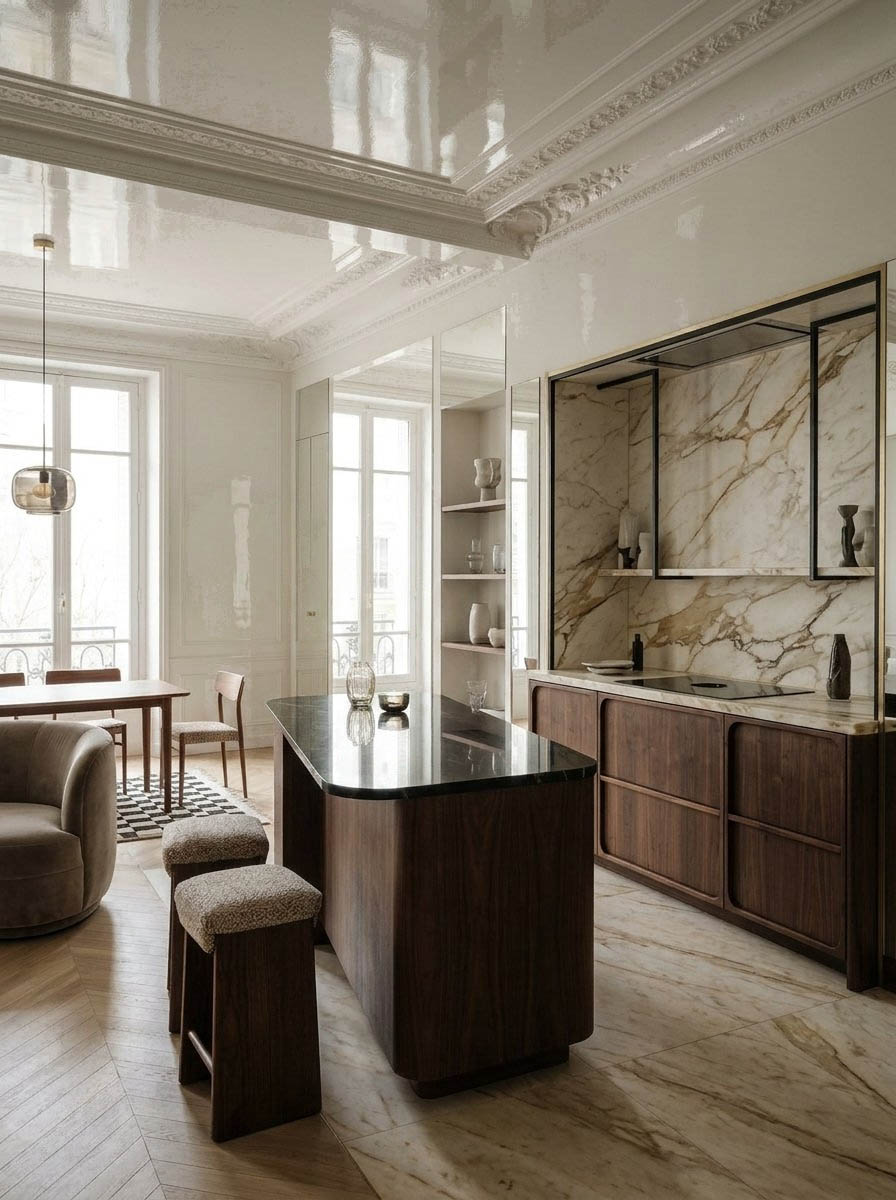
The most restrained kitchen of the five - and the one that makes the most persuasive case for gloss as a tool of architectural subtlety rather than surface drama. A Haussmann apartment dressed in cream walls, herringbone parquet, and deep walnut cabinetry is given its defining quality by a single overhead decision: the ceiling, lacquered to a high cream gloss that reflects the tall French windows and floods the room with borrowed daylight.
In this context, the gloss ceiling is not a statement - it is a service. It extends the room's light horizontally, making the kitchen appear to float in a luminous envelope rather than sit beneath a flat plane. The Calacatta marble splashback, framed in thin black metal, mirrors this quality at the wall - stone so veined and alive that it performs like a painting. Together, the gloss ceiling and marble wall create a room defined by surfaces that look back at you.
The walnut island - curved at its base, topped in black stone - anchors the room with warm material weight. This is the essential counterpoint in any gloss-heavy kitchen: one matte, warm, organic element that gives the eye somewhere to rest.
Design tip: In period apartments, a gloss ceiling reads as a refined nod to the lacquered salons of the 18th century - it honours the architecture rather than fighting it.
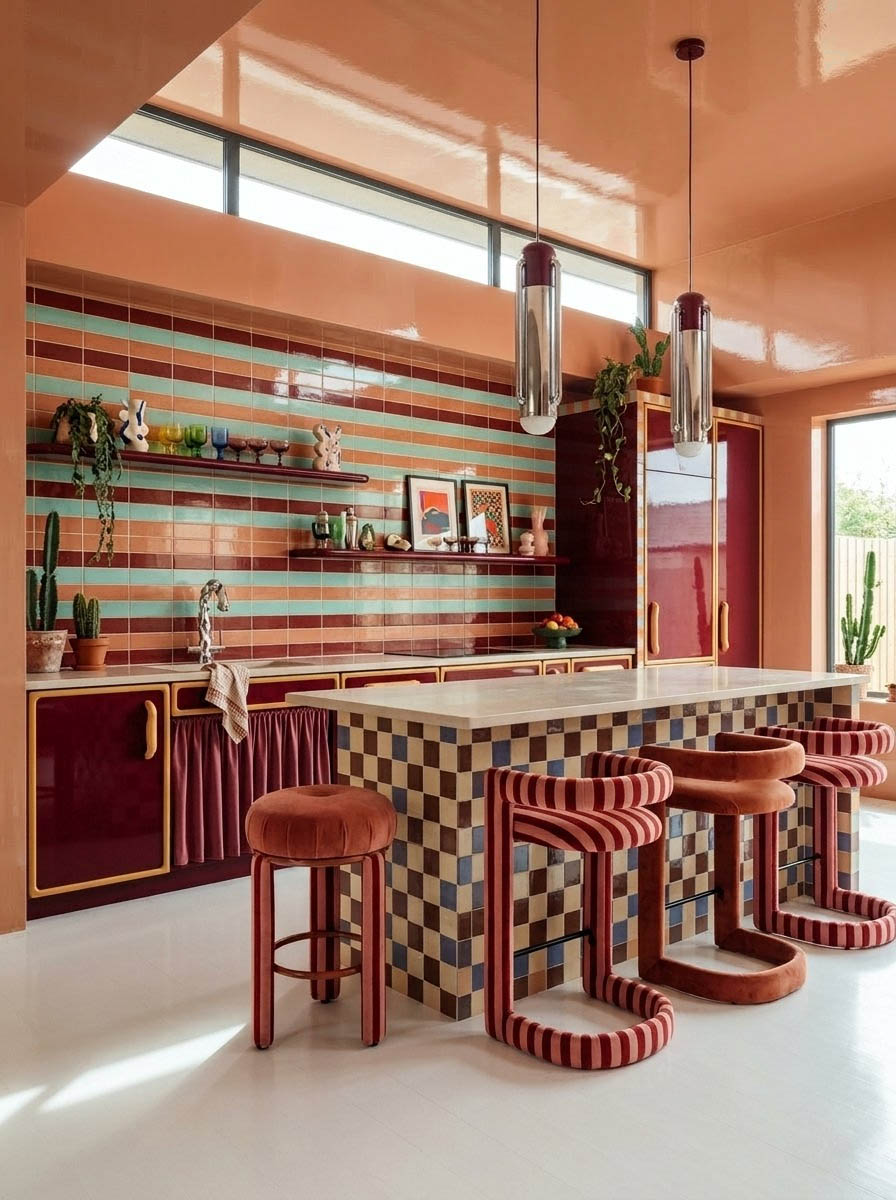
The most exuberant kitchen of the five - and the one that proves that high gloss is not the preserve of the minimalist. A terracotta-pink ceiling lacquered to a mirror sheen hovers over a riot of striped tile, chequerboard island, lacquered crimson cabinetry, and sculptural candy-striped bar stools. The room is a love letter to pattern, color, and the pleasures of extreme commitment.
What holds this together - what prevents it from dissolving into chaos - is precisely the gloss ceiling. Its reflective surface creates a unifying plane above all the pattern below, gathering the room's chromatic energy into a single overhead statement. The gloss acts as an editor: it amplifies the colors beneath it while giving the eye a single, coherent surface to return to when the pattern becomes overwhelming.
The lacquered crimson refrigerator cabinet is another crucial element. Gloss on a tall vertical surface in a kitchen is a bold choice - it turns what is usually the room's most utilitarian object into a piece of furniture. The gold hardware, the frilled cotton sink curtain, the open shelving displaying coloured glass - all of these are decisions that only work in a room where the surfaces are already this confident.
Design tip: In a maximalist kitchen, a gloss ceiling in the dominant color unifies the pattern below - it is the lid that holds the composition together.
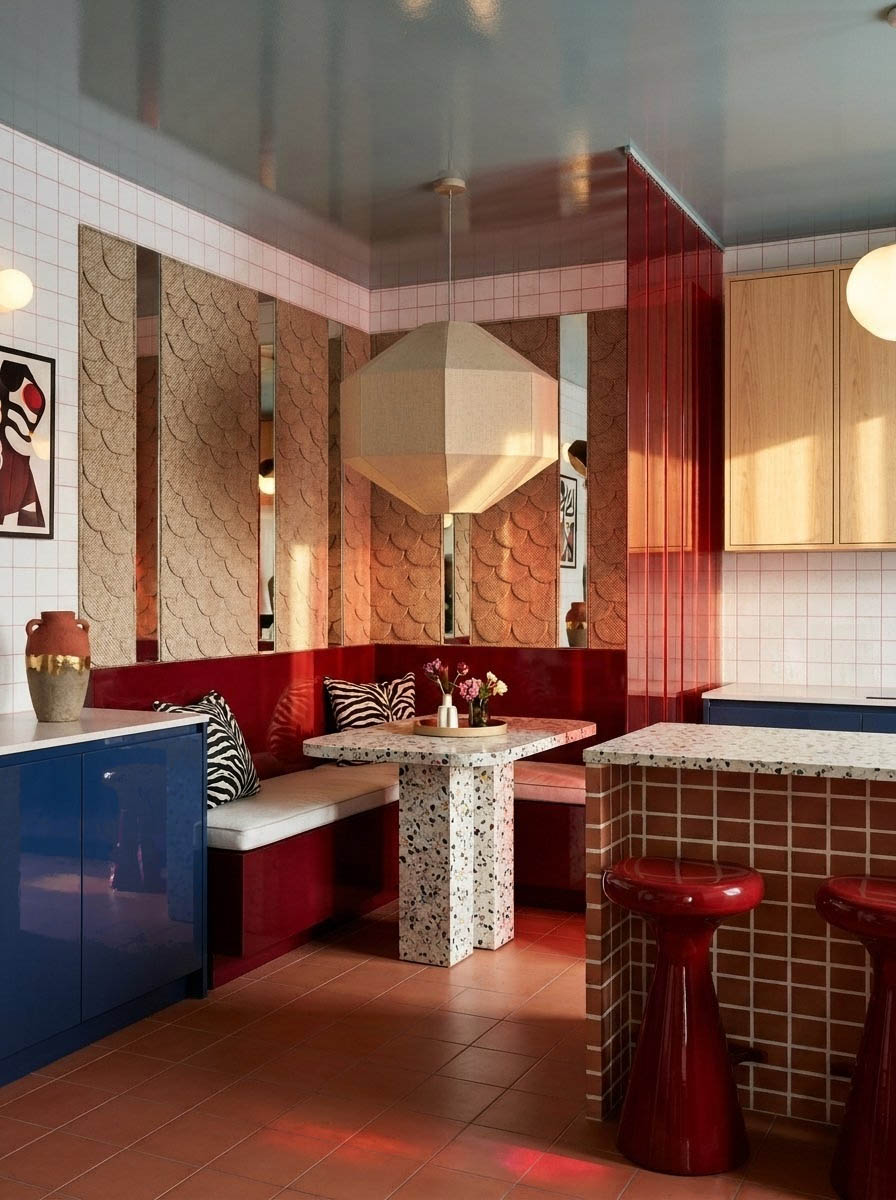
This kitchen-diner reframes gloss entirely - not as cool and crystalline, but as warm, enveloping, and deeply atmospheric. A high-gloss teal-blue ceiling hovers over a space dominated by lacquered ruby red: a deep, upholstered banquette, a structural pillar in the same red gloss, and a terracotta tile floor that grounds the whole composition in earth tones. The interplay of these two glossy surfaces - teal above, ruby below - creates a color conversation that makes the room feel lit from within.
The terrazzo table and bar-height counter are the room's material heart: their organic, speckled surface provides the tactile, matte contrast that all gloss-heavy rooms need. Without terrazzo, marble, or natural stone, a room this committed to reflective surfaces risks feeling hard and cold. With it, the gloss becomes context - a frame for the natural material rather than the entire story.
The fish-scale textured wall panels behind the banquette are the room's most unexpected decision - a matte, organic texture placed precisely where the eye rests most. Mirror strips interrupt the panels at regular intervals, creating a rhythm of reflection and absorption that gives the dining nook the quality of a private booth in a very sophisticated restaurant.
This space addresses searches for "kitchen dining nook ideas," "banquette seating kitchen," and "bold kitchen colour ideas" - all high-intent queries from homeowners planning major projects.
Design tip: Pair a gloss ceiling in a cool tone with lacquered cabinetry or furniture in a warm tone - the contrast between the two creates the room's entire emotional register.
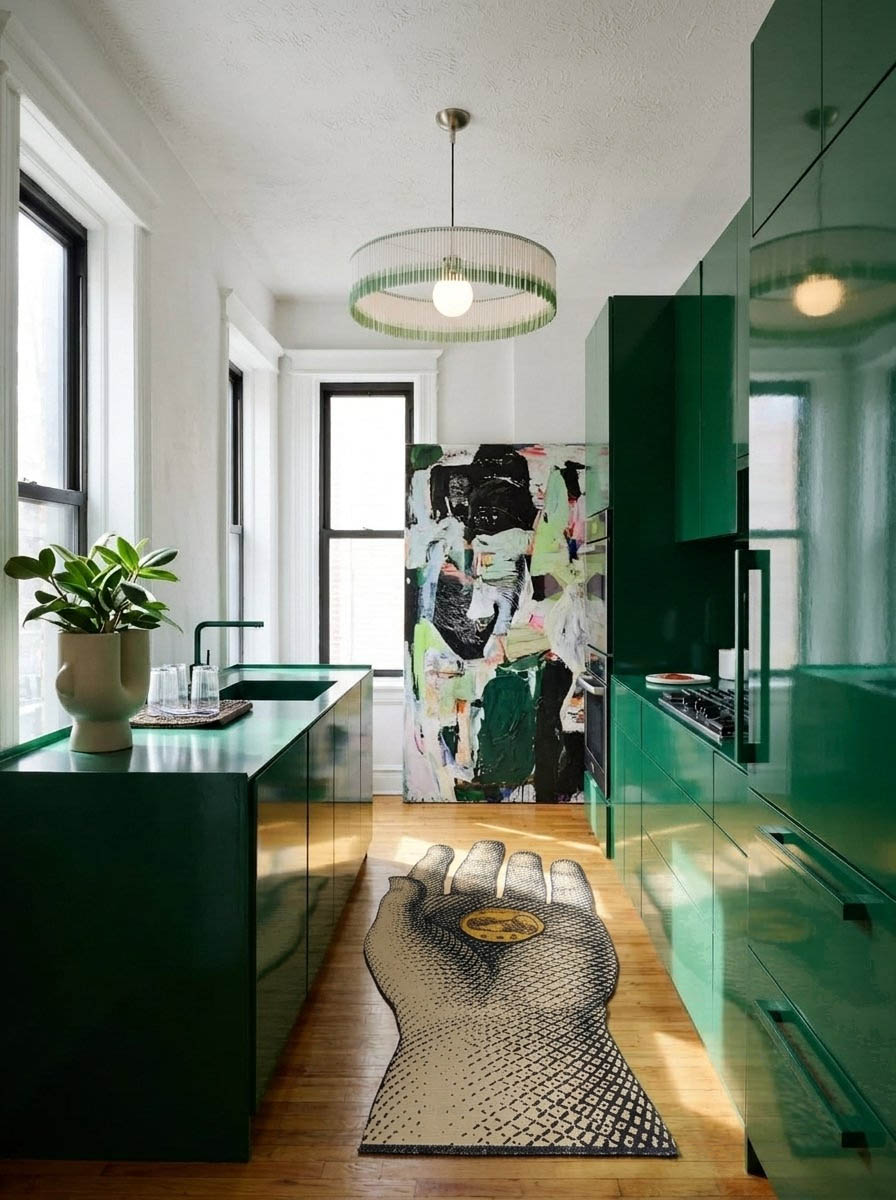
The most committed kitchen of the five - and the one that makes the definitive case for high gloss as a complete design language. Floor-to-ceiling emerald green cabinetry, lacquered to a mirror sheen on both sides of a galley corridor, creates a tunnel of concentrated colour and reflected light that is genuinely unlike anything a matte finish could achieve. The room does not merely contain green - it is green, in the way that a forest is green: total, immersive, alive.
The floating cabinetry detail - raised off the oak floor to reveal a strip of warm timber beneath - is the masterstroke that prevents the room from feeling oppressive. That single visual gap, with light spilling beneath the lower cabinets, gives the joinery a lightness that contradicts its visual weight. The warm oak floor performs the same function as the timber desk in the lime home office: it is the one element that anchors the cool, saturated green to something organic and human-scaled.
The large-scale abstract painting - positioned against the emerald cabinetry like a deliberate collision - is the room's most audacious decision. To hang art in a kitchen is already unusual; to hang art that competes with emerald lacquer for visual authority requires absolute confidence in both. The painting's blacks, pinks, and greens pull from the cabinetry colour while refusing to be subsumed by it. The hand-shaped rug below continues the room's commitment to the unexpected: this is a kitchen that knows it is also a gallery.
High gloss on every surface creates sensory overload. One matte, organic element — stone, timber, linen — gives the eye a resting point and makes the gloss feel intentional rather than relentless.
A gloss ceiling transforms a kitchen without touching the cabinetry. It amplifies daylight, borrows views, and makes even a modest kitchen feel like it belongs somewhere grander.
White gloss reads clinical. Cream gloss reads Parisian. Cobalt gloss reads dramatic. Emerald gloss reads immersive. The same finish performs completely differently depending on the colour carrying it.
High gloss is unforgiving - it reveals every imperfection beneath it. Sanding, priming, and multiple thin coats are non-negotiable. The beauty of gloss is entirely dependent on the quality of the surface beneath it.
Gloss surfaces perform differently at different times of day and under different light sources. Commission your lighting alongside your finishes — not as an afterthought. Warm filament bulbs soften gloss; cool LEDs harden it.
A gloss floor and a gloss ceiling together is an advanced move that requires everything in between to be very carefully resolved. For most kitchens, one reflective plane is the more liveable and more elegant choice.
High gloss asks you to commit - to a color, to a finish, to a way of living with surfaces that talk back. The kitchens featured here do not equivocate: they have chosen gloss not as a default but as a conviction, and the result in each case is a room that feels more alive, more considered, and more memorable than a matte alternative would ever have been.
The reason gloss is having its most sophisticated moment in the kitchen - rather than the living room or the bedroom - is precisely because the kitchen is where practicality so often wins. When a designer chooses to put a high-gloss lacquered finish in the most hardworking room in the house, it signals a refusal to let function override beauty. It says: this room is also a room to live in, to look at, to be moved by.
Whether you begin with a single gloss ceiling or commit to a full emerald lacquer from floor to cornice, the principle is the same: light is the material, and gloss is the tool with which you shape it. The kitchens that understand this are the ones that endure.
Create your own high gloss interior fantasy at MattoBoard.com

.jpg)