Dopamine decor is the design movement that puts joy at the centre of every decision — using saturated color, bold pattern, and fearless material choices to create spaces that actively improve your mood. From an all-over crimson bathroom to a jungle-green hallway and a hand-painted terracotta arch room, these five spaces prove that color is not decoration, it is architecture. This is maximalism with a purpose: homes that don't just look beautiful, but make you feel something every single time you walk through the door.
.jpg)
"Dopamine decor is not about excess for its own sake. It is about designing spaces that make you feel something of joy, surprise, delight - every single time you walk into them."
Something shifted in the way we think about our homes after the world stood still. The muted, the restrained, the carefully neutral - interiors that had once felt sophisticated began to feel like deprivation. In their place, a new design philosophy emerged: one rooted in color psychology, sensory pleasure, and the radical act of choosing joy as a design brief. Dopamine decor has arrived - and these five spaces show exactly what it looks like at its most considered, most exuberant, and most genuinely alive.
The term "dopamine decor" entered the design lexicon properly around 2022, but the impulse behind it is far older. At its core, it is a color psychology principle: that our environments directly affect our neurochemistry, and that spaces designed to trigger positive emotional responses - through saturated color, pattern, playfulness, and material richness - can genuinely improve mood, creativity, and wellbeing. This is not pseudoscience. Decades of environmental psychology research supports the link between color saturation and emotional arousal, between pattern complexity and mental stimulation, between spaces that surprise us and the neurological reward of novelty.
"The post-pandemic interior was not simply a reaction against minimalism. It was a demand - urgent, almost physical - for spaces that gave something back."
Historically, maximalism and exuberant color have always surged in the aftermath of periods of austerity or anxiety. The Roaring Twenties followed the bleakness of World War One with jazz, Art Deco's gilded geometry, and interiors of unapologetic opulence. The psychedelic explosion of the 1960s came after the conformist grey of the postwar decade. The flamboyant color of the 1980s followed the austere recession years of the late 1970s. Design, it seems, has always known that after deprivation comes a hunger for delight.
What makes the 2020s iteration distinctive is its self-awareness. Earlier maximalist movements were often about display - wealth, status, novelty. Today's dopamine decor is more personal and more intentional. It draws explicitly on color theory, on the vocabulary of folk art and global craft traditions, on the emotional grammar of childhood memory and cultural identity. It is maximalism with a thesis.
The aesthetic also reflects a broader cultural shift in how we talk about mental health. As conversations about emotional wellbeing entered the mainstream, the idea that your home could be an active participant in your mood — not just a backdrop to it — became genuinely compelling. Choosing a crimson bathroom or a jungle-green hallway became less an act of bravado and more an act of self-care.
There is nothing tentative about this bathroom. Floor-to-ceiling crimson ribbed tiles on every wall, a deep red toilet, a terracotta vessel basin, and neon-pink strip lighting that turns the shower into something closer to a stage. This is dopamine decor in its purest, most committed form: a space designed entirely around the emotional charge of a single saturated color.
Red is the most physiologically activating color in the spectrum. Research consistently shows it raises heart rate, increases energy levels, and creates a sense of heightened alertness — qualities that make it a counterintuitive but genuinely powerful choice for a bathroom. This is not a room designed for long, meditative soaks. It is designed for the morning: the kind of space that sends you out into the world feeling ignited.
The ribbed tile texture is essential to the room's success. A flat crimson tile at this scale would feel oppressive; the ribs create a play of light and shadow across the surface that gives the color dimensionality and movement. The neon light underneath the floating vanity adds a second layer of drama - a pink halo that warms the red rather than clashing with it. Even the round globe pendants, the chrome fixtures, and the simple frameless shower screen have been chosen for their ability to sit inside the color rather than interrupt it.
This is not a bathroom that will photograph well and then tire you. This is a room that rewards daily life with daily pleasure - and that, at its heart, is what dopamine decor is for.
Design tip: A monochrome bathroom in a saturated color is the single most transformative dopamine decor move - it costs no more than a neutral bathroom and delivers exponentially more emotional impact.
.jpg)
Hallways are the most overlooked rooms in the house — passed through rather than inhabited, decorated as afterthoughts rather than destinations. This space rejects that logic entirely. A gloss coral-pink ceiling, terracotta chequerboard floor tiles, arched openings, a fluted plaster column, and warm timber joinery create a corridor that is as considered as any living room, and far more surprising.
The genius of dopamine decor in a hallway is that the hit is concentrated. You experience the space in a few seconds — which means every element must perform immediately and memorably. The gloss ceiling catches the light from the arched opening ahead and bounces it back as warm amber; the chequerboard tiles draw the eye forward with graphic momentum; the fluted column introduces a sculptural element that has no practical justification beyond pure visual pleasure. Together, they turn a functional transition space into a daily moment of genuine delight.
The color palette here is earthy and warm — coral, terracotta, blush, sand — which prevents the dopamine charge from feeling jarring. This is maximalism that feels Mediterranean rather than metropolitan, rooted in craft traditions and natural pigments rather than synthetic brightness.
Design tip: The hallway is dopamine decor's most efficient canvas - a small space that delivers maximum impact for the lowest investment.
.jpg)
Step through this doorway and you step into another world. Deep forest green walls, ornate plasterwork ceilings, cobalt blue encaustic tiles on the floor, layered rugs, tropical plants, and multiple doorways opening onto further rooms of contrasting color - this is dopamine decor as world-building, the creation of an immersive environment that bears no relationship to the grey street outside.
What makes this space work as design rather than simply as spectacle is the quality of the decisions within the color. The green is not one green - it deepens toward the cornice, lightens toward the skirting, and shifts across the day as the light through the tall windows changes. The cobalt floor tiles relate to the artwork propped against the console, which relates to the teal pouffe visible in the room beyond. Nothing here is accidental: the apparent spontaneity is the result of very careful curation.
This space embodies the dopamine decor principle that color should tell a story. Walking through it, the eye makes connections - between the green and the plants, between the blue tiles and the blue doorframe - that create a sense of discovery and richness that purely neutral interiors can never provide. It rewards looking, and rewards looking again.
Design tip: In a color-rich space, use plants as a living extension of the palette - they blur the line between decoration and nature, giving the dopamine charge an organic, grounded quality.
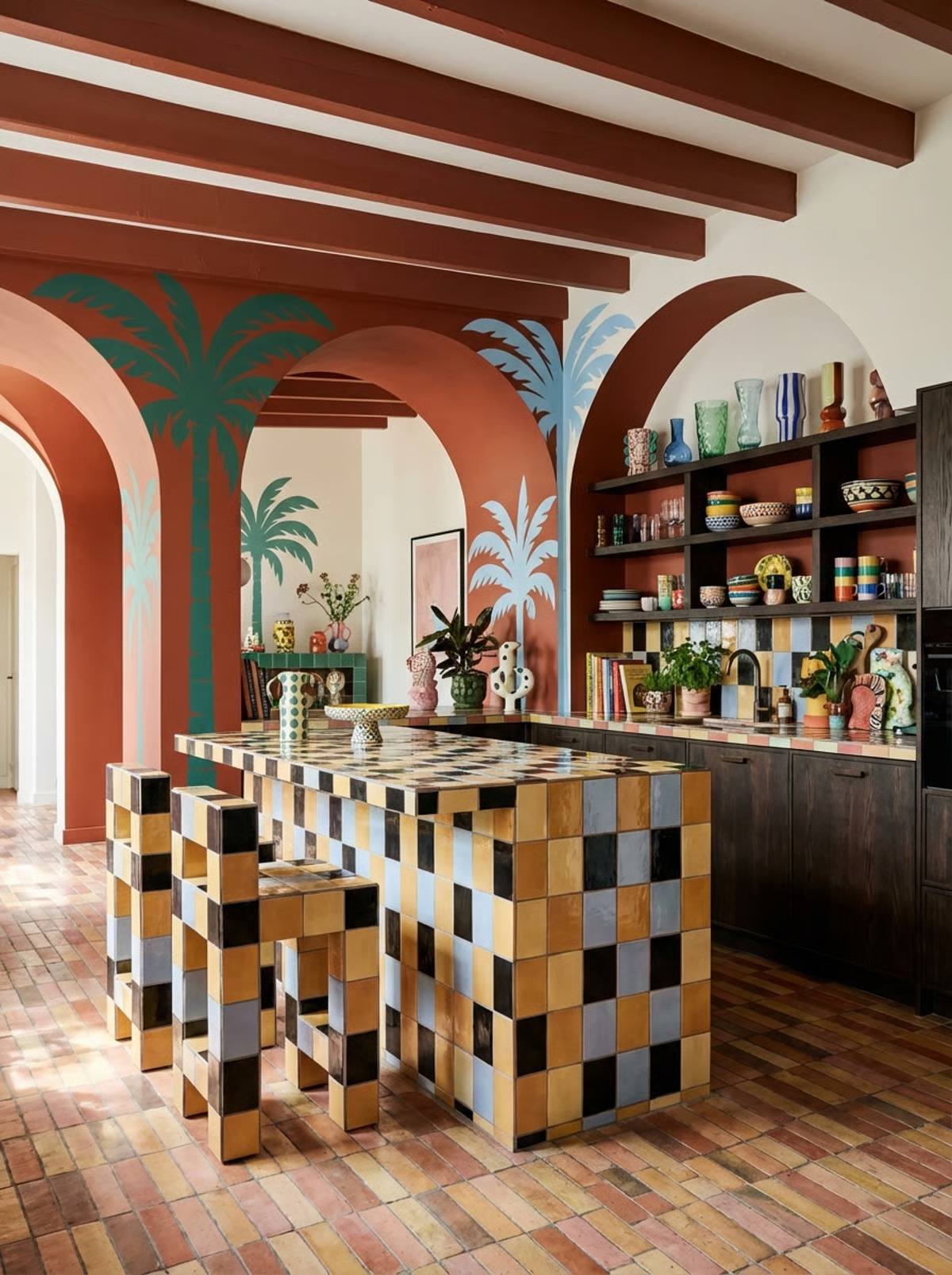
This is the most culturally rich space of the five - and the one that most explicitly connects dopamine decor to the global craft traditions that have always understood color as a language of celebration. Terracotta brick floors, painted terracotta arches with hand-stencilled palm motifs, exposed timber ceiling beams, a monumental chequerboard island in sand, black, and teal, and shelving laden with ceramics in every colour of the Mediterranean spectrum. This is a room that has absorbed the visual wisdom of Moroccan riads, Mexican haciendas, and Portuguese azulejo tile-making and synthesised them into something completely personal.
The painted arch motif is the room's defining gesture. By painting the interior curve of each arch with a different decorative treatment - palm trees against sky blue - the designer has turned a structural element into an illustration, a piece of permanent folk art that will look as fresh in twenty years as it does today. This is dopamine decor at its most considered: joy that is also craft, exuberance that is also skill.
The chequerboard island deserves its own analysis. Four colors - sand, black, grey, and teal - are combined in a chequerboard pattern that relates to the encaustic tile tradition while feeling completely contemporary. The scale of the check (large, not fine) prevents it from reading as fussy and gives the island the quality of an object rather than a surface. It is the kind of piece you would design for a room you intend to love for a very long time.
.jpg)
The final space makes the most sophisticated argument of the five: that dopamine decor does not require total immersion to deliver its charge. A single wall of deep cobalt blue - painted, not tiled - anchors a bathroom that is otherwise composed of calm, considered materials: a terrazzo floor in soft grey and white, white subway tile on the remaining walls, simple white cabinetry, and natural stone surfaces. The color does not fill the room. It punctuates it.
The bubble mirror - cobalt blue frame, circular form - picks up the wall color and turns it into a design object, while the dark navy vanity unit below grounds the composition and prevents the blue wall from floating. This is the dopamine hit delivered with a light touch: a room that surprises without overwhelming, that makes you smile without making you dizzy.
This space is particularly important in the context of the dopamine decor conversation because it answers the most common objection: "I love the idea but I could never live with it." The cobalt bathroom proves that you can access the emotional pleasure of saturated color through a single confident decision - one wall, one piece of furniture, one mirror frame - without committing every surface to the cause. It is dopamine decor for the color-curious rather than the color-converted, and it is just as valid.
For searches like "how to add color to a bathroom without going too bold" or "navy bathroom accent wall ideas," this room is the perfect editorial answer.
Design tip: A single saturated wall in an otherwise neutral bathroom delivers the dopamine hit without the commitment — start here if you are new to bold color, and see how quickly you want more.
Before choosing a color or pattern, ask: does this make me feel something? If the answer is yes - even if the feeling is surprise or slight unease - you are probably on the right track.
Dopamine decor does not require every surface. One saturated wall, one patterned floor, one painted ceiling - a single committed decision delivers the full emotional charge of the trend.
Use color for immediate emotional impact, and pattern to reward sustained looking. The most successful dopamine interiors do both - but they never confuse the two.
Terracotta, timber, stone, rattan, and linen all absorb the shock of saturated color and make it feel rooted rather than synthetic. They are the material ballast of the dopamine interior.
Bathrooms, hallways, powder rooms, and utility rooms are the best places to experiment with dopamine decor. You spend short, intense bursts in them - which is exactly how saturated color performs best.
The richest dopamine interiors borrow from the visual grammar of Moroccan zellige, Mexican Talavera, Portuguese azulejo, and Indian block-print. These traditions have spent centuries understanding how color and pattern create joy.
Dopamine decor is, at its root, an argument about what homes are for. If a home is merely a container - a backdrop for living - then neutrality is perfectly rational. But if a home is a participant in the quality of your daily experience, a space that can actively improve your mood, stimulate your senses, and remind you that beauty is not a luxury but a form of nourishment, then the calculus changes entirely.
The five spaces featured here make that argument not in words but in paint, tile, and pattern. They are rooms that do not ask permission to be joyful. They commit to color as a value, to pattern as a pleasure, and to the idea that the most radical thing a room can do in 2025 is to make you feel genuinely, unreservedly glad to be inside it.
That is not a trend. That is a philosophy. And like all the best philosophies, it turns out to be surprisingly hard to argue with once you have lived inside it.
Create your own dopamine interior fantasy at MattoBoard.com
.jpg)