
Milanese interiors are having a moment, defined by historic grandeur, sculptural forms and a quiet sense of confidence. These five spaces show how rich materials, considered proportions and timeless design choices create interiors with real gravitas.
.jpg)
There is a particular quality that the greatest Milanese interiors share - a quality that is difficult to name but instantly recognizable. It is not minimalism, not maximalism, not any of the familiar categories that contemporary design criticism reaches for. It is something closer to gravitas: a sense that every material, every proportion, every piece of furniture has been chosen not because it is fashionable or beautiful, but because it is correct. In 2026, that quality is more sought-after - and more rarely achieved - than ever before. These five spaces have it completely.
Milan's relationship with interior design is unlike that of any other city in the world. Where Paris exports the idea of elegance, London the idea of eccentricity, and New York the idea of power, Milan exports something more specific and more elusive: the idea of culture applied to daily life.
The Milanese interior is the product of a civilization that has been thinking seriously about how to live beautifully for several centuries - and that accumulated cultural intelligence is visible in every proportion, every material choice, every piece of furniture that appears in the city's most considered apartments.
The Milanese palazzo apartment - typically occupying the piano nobile of a 17th or 18th-century building, with its frescoed ceilings, marble floors, floor-to-ceiling windows, and two-meter-thick walls - is the foundational architectural context from which the Milanese interior tradition emerges. These are spaces of extraordinary physical generosity: high-ceilinged, proportionally rigorous, flooded with northern Italian light that is at once bright and somehow always slightly golden. Designing within them demands a corresponding generosity of material and ambition.
The 20th century gave the Milanese interior its defining modern identity through a generation of designers who understood that the city's historic architecture was not a constraint to be overcome but a collaborator to be listened to. Gio Ponti, who spent his entire career in Milan, produced interiors that honored the city's architectural tradition while infusing it with his own playful, brilliant contemporaneity. Piero Fornasetti brought surrealism and classical motif into domestic spaces with a wit and craft that has never been replicated. The furniture designers of the 1960s and 70s - Cassina, Arflex, B&B Italia - produced pieces of such formal intelligence that they remain, fifty years later, the standard against which all subsequent Italian furniture is measured.
What defines the Milanese interior in 2026 is the same quality that has always defined it: a profound respect for material, a confidence in scale, and an understanding that the most sophisticated spaces are those that make you feel the weight of the culture that produced them. These five spaces embody that understanding completely.
The most culturally layered space of the five - and the one that most perfectly captures the essential quality of the Milanese interior: the coexistence of the deeply historic and the entirely contemporary, resolved not through compromise but through absolute confidence. A palazzo kitchen with a frescoed ceiling of extraordinary detail - its painted clouds and figures the work of a 17th-century hand - sits above a sleek, matte steel kitchen island, a fragment of blue-veined marble, a classical plaster bust, and chairs of quietly radical Modernist design. Nothing here explains itself. Everything here is simply correct.
The steel island is the room's most decisive contemporary gesture. In a kitchen of this historic pedigree - soaring ceilings, Murano chandeliers, arched doorways giving onto further grand rooms - a less confident designer might have retreated to stone or timber, something warm and traditional that would not disturb the frescoes above. The matte steel makes no such concession. It stands in this room on its own terms, neither imitating the past nor rejecting it, and the result is a kitchen that feels genuinely of the present moment while being entirely at home in its centuries-old context.
The classical bust on the island - positioned with the casualness of a vase of flowers - is the room's most Milanese detail. In Milan, objects of genuine cultural and historical significance are not displayed; they are simply lived with. The sculpture is not a trophy or a collector's piece in this context. It is furniture. That quality of taking beauty and history entirely for granted is the city's most distinctive and most enviable characteristic.
Design tip: Placing contemporary furniture and appliances inside a historic architectural shell works only when both elements are of the highest quality - it is not the contrast that creates the effect but the equal confidence of each.
Explore this concept and design your own.
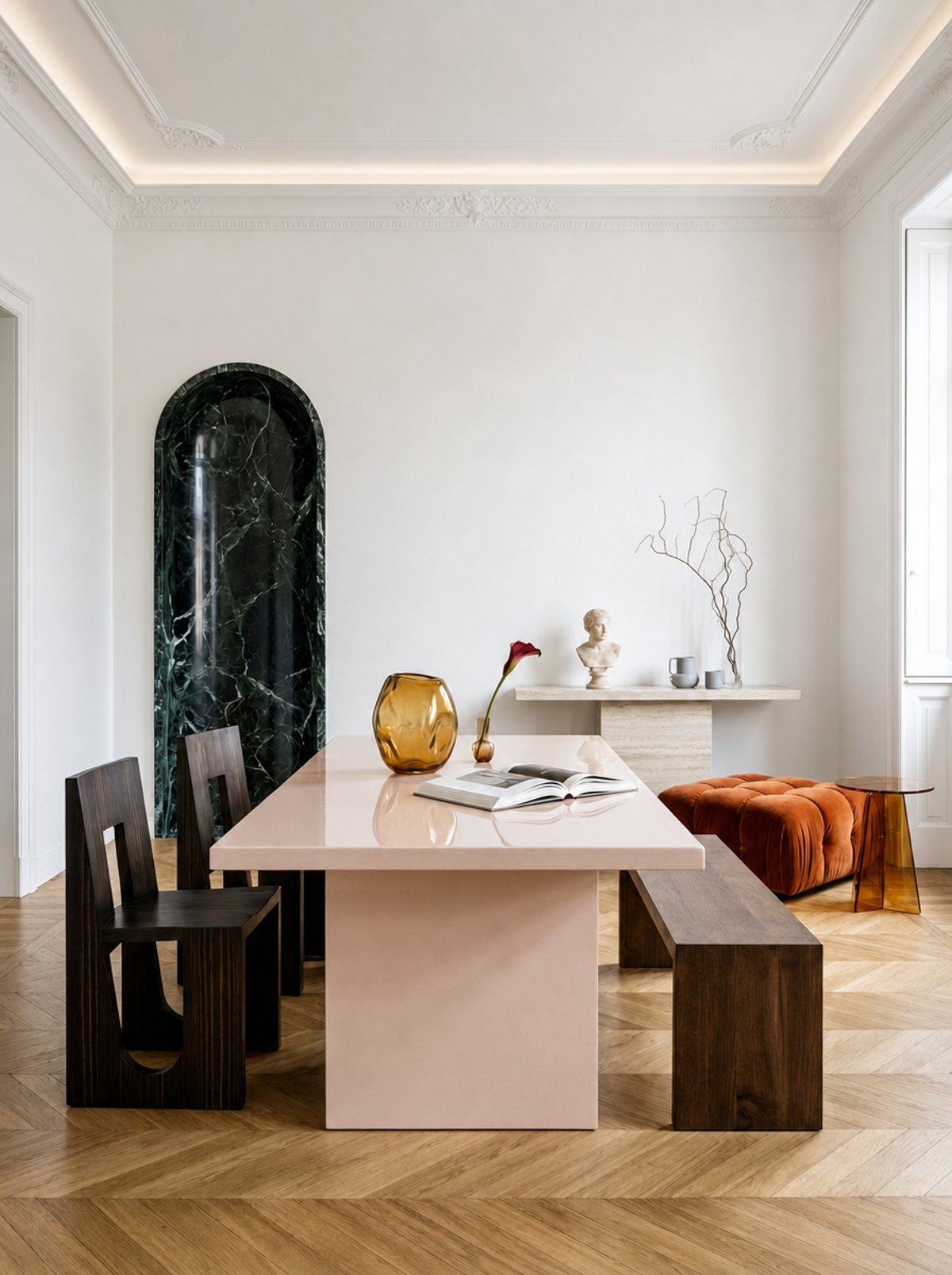
This dining room makes a single, decisive architectural gesture — and then has the confidence to stop. A tall, narrow arch of deep green Marquina marble, set against a white plaster wall, acts as the room's entire decorative program: no artwork, no shelving, no secondary elements competing for attention. The marble arch is the room, and everything else - the blush travertine dining table, the dark sculptural chairs, the parquet floor - exists to honor rather than rival it.
The Marquina marble, with its fine white veining, is one of the most formally dramatic stones in the Italian quarrying tradition, and its use here as a full-height architectural element rather than a surface treatment gives it a monumentality that is entirely Milanese in spirit. The arch's perfect proportions - slightly narrower at the top, deeper than it appears at first glance, commanding without being aggressive - demonstrate the kind of architectural drawing that comes from centuries of engagement with classical form.
The blush table is a perfect counterpoint: warm where the marble is cool, horizontal where the arch is vertical, tactile where the polished stone is smooth. Against the herringbone parquet floor, the amber glass vessel on the table, and the carved amber object beside it, the room assembles itself into a composition of extraordinary material intelligence - a room that has chosen five elements and made each one perfect.
Design tip: A single architectural element in exceptional stone - an arch, a fireplace surround, a full-height panel - can constitute the entire decorative program of a room. The Milanese tradition has always understood that true luxury is the ability to stop adding.
Explore this concept and design your own.
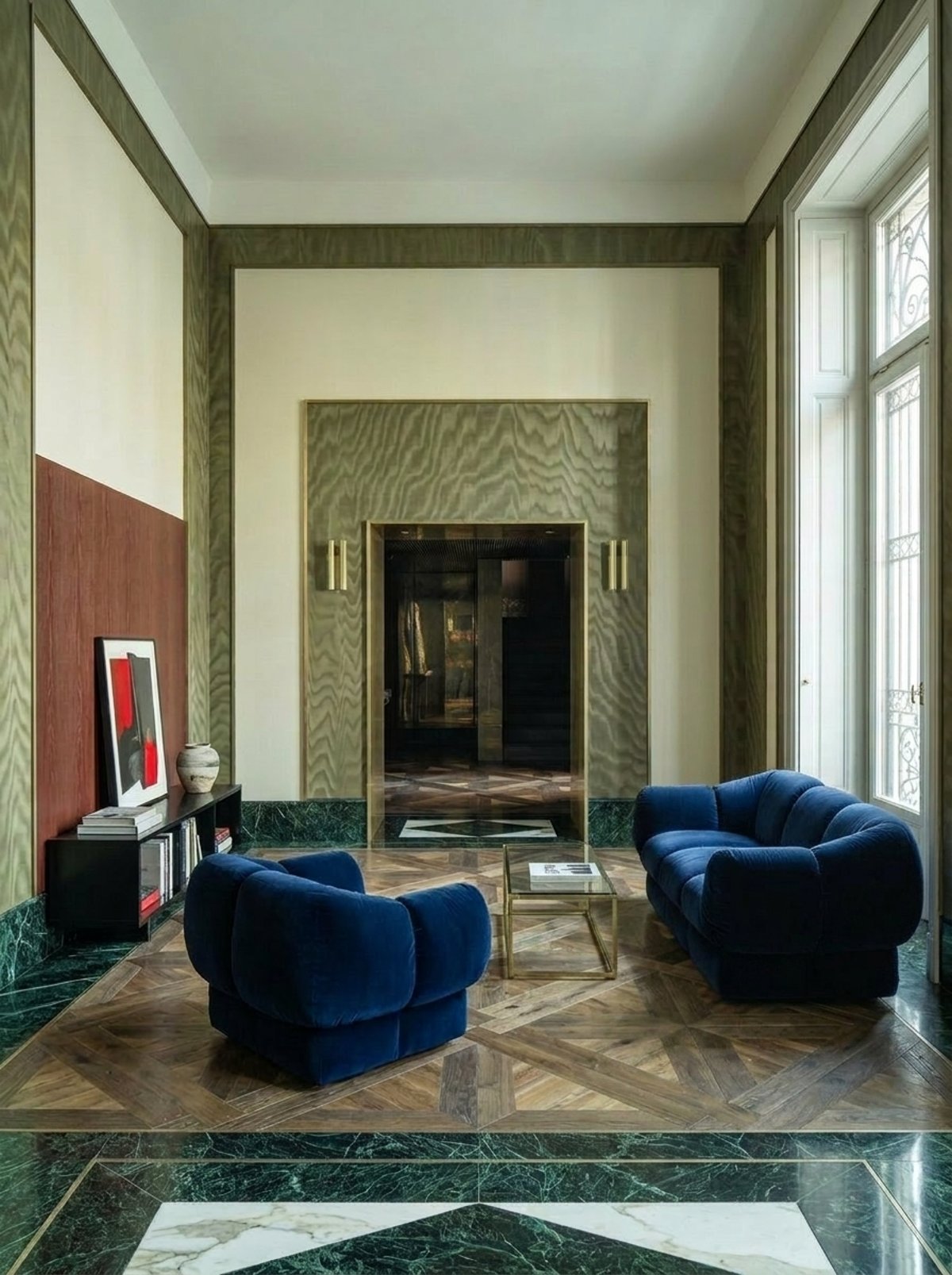
The most materially opulent space of the five - and the one that most completely demonstrates the Milanese willingness to use natural stone not as an accent or a surface but as the room's primary color palette. Verde marble - in its deepest, most richly patterned form, its swirling grey-green tones shot through with darker veining - covers the fireplace surround, the chimney breast, and the architrave around the tall windows, turning the room's most architecturally significant elements into a continuous study in one of nature's most complex color compositions.
Against this verde backdrop, a pair of cobalt blue velvet sofas - their deeply tufted, sculptural forms immediately recognizable as classics of Italian furniture design - provide the room's human-scaled anchor. The cobalt blue relates to the cooler tones within the verde marble while providing the saturated, upholstered warmth that prevents the room from reading as a geology exhibition rather than a living space. This is the Milanese color intelligence at its most refined: finding the color already present within the stone and reflecting it back in a softer, more inhabited form.
The inlaid marble floor - geometric, precise, its pattern echoing the architectural grammar of the room's paneling and architraves - is the room's most historically knowing detail. Inlaid marble floors of this complexity are a tradition that runs from the floors of Roman churches through the baroque palaces of Naples to the great Milanese apartments of the 19th century. In 2026, they read as both deeply traditional and entirely fresh.
Design tip: When using a heavily patterned stone like verde marble at architectural scale, find its dominant undertone - cool grey-green, warm amber, deep burgundy - and echo it in the room's upholstery. The stone and the fabric will appear to have chosen each other.
Explore this concept and design your own.
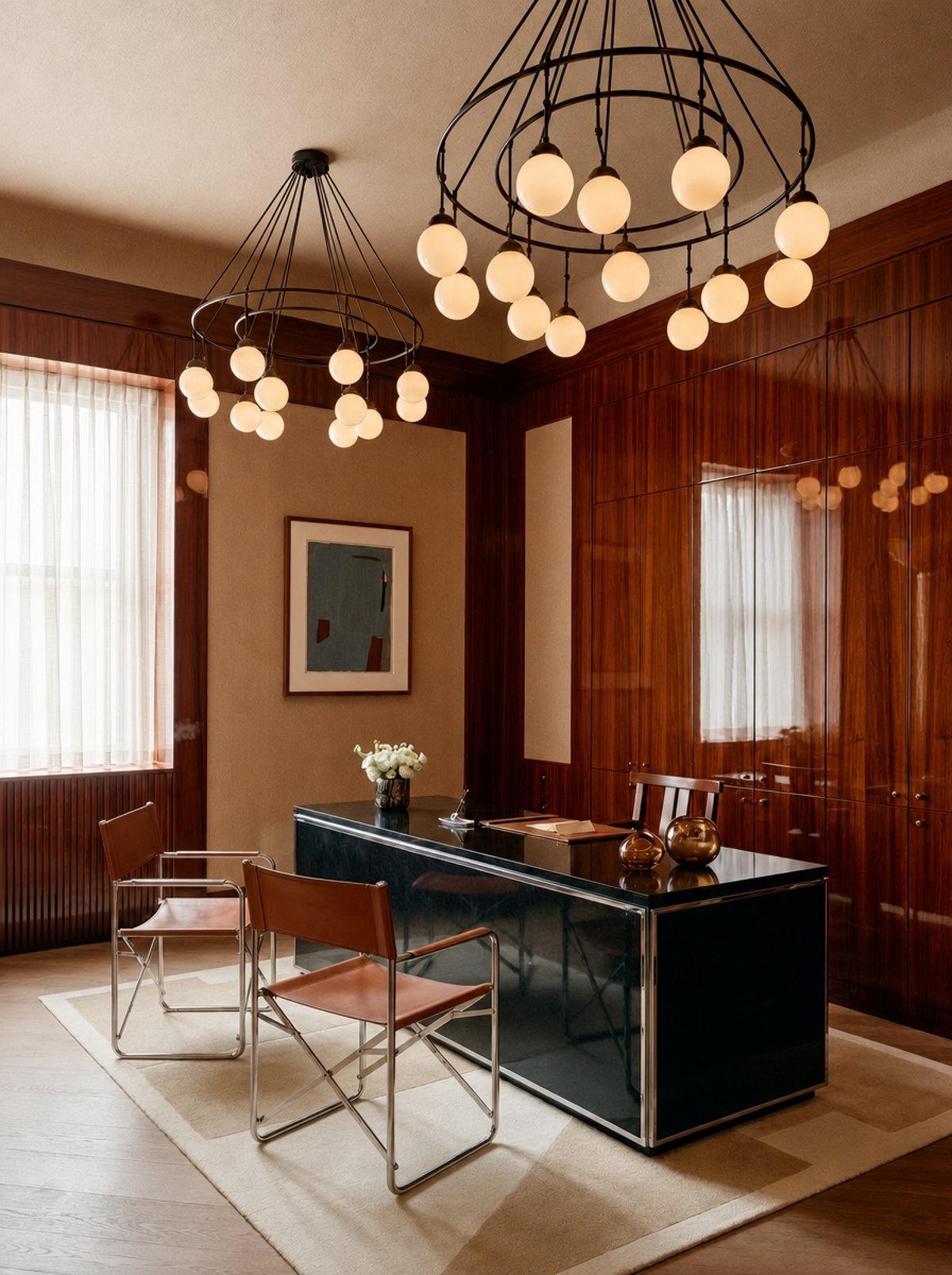
The most intimate space of the five - and the one that demonstrates that the Milanese interior does not require coolness or restraint to achieve its characteristic authority. A home study lined in deep terracotta lacquered wood paneling, with a monumental black marble-topped desk, leather and chrome chairs, and a globe chandelier of black metal and warm glass spheres - this is a room of deeply warm, deeply saturated color that nonetheless feels entirely controlled and entirely serious. The warmth here is not decorative. It is architectural.
The wood paneling is lacquered to a finish that sits between matte and satin - just enough reflectivity to give the deep color a sense of depth and richness without tipping into the glamour of high gloss. The panels' proportion and joinery are immaculate: aligned with the window height, finished with simple shadow-gap reveals, and detailed at the cornice with the same quiet precision as the room's other architectural elements. Milanese interiors are invariably the product of extraordinary craft at every scale, and this room is no exception.
The black marble desk - slab-like, horizontal, monumental - is the room's material counterweight to the warmth of the paneling. Its cold, dark surface against the terracotta walls creates exactly the kind of warm-cool tension that makes a room feel genuinely considered rather than simply decorated. The leather Wassily chairs, with their tubular chrome frames and tan leather slings, provide the room's modernist credentials, a nod to the Bauhaus tradition that Italian design absorbed and transformed in the mid-20th century.
Design tip: Lacquered wood paneling in a deep, warm color - terracotta, burgundy, forest green - gives a study or home office the gravitas of a private library without a single book on the shelf. The finish quality is everything: satin rather than gloss, and always precision-joined.
Explore this concept and design your own.
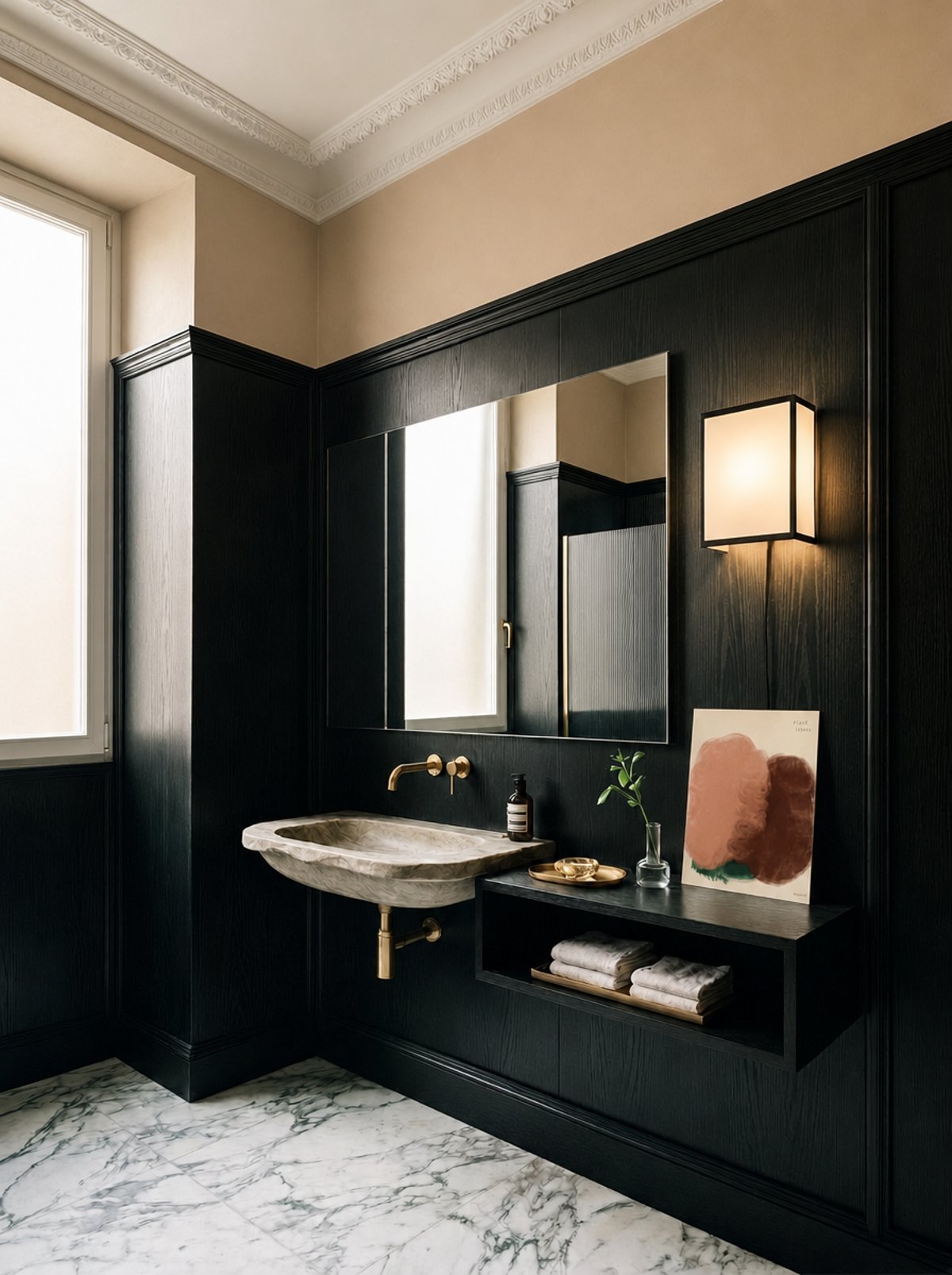
The final space makes the most austere argument of the five - and in the Milanese tradition, austerity is not an absence of luxury but its most concentrated form. A bathroom of near-total darkness: matte black cabinetry with a fluted surface that creates a rhythm of shadow and depth, a wall-mounted basin in creamy Carrara marble with its characteristic grey veining, brass fixtures and hardware that catch the limited light and hold it warmly, and a window that floods the far end of the room with pale northern Italian light against which the black surfaces read as a deep, almost marine darkness.
The Carrara marble basin is the room's single material concession to warmth and organic texture, and it performs this function with complete elegance. Against the matte black cabinetry, the marble's creamy white surface appears to glow - the contrast between the two materials is so precisely calibrated that neither would be as beautiful without the other. This is the Milanese principle of material selection at its most rigorous: every element chosen not in isolation but for what it does to the elements around it.
The fluted black paneling - its vertical ribs creating a shadow rhythm across the wall - is the detail that elevates this bathroom from a dark, practical space into something genuinely architectural. The ribs reference the pilasters and classical orders that appear throughout Milan's historic buildings, translated into a domestic material and context with the kind of cultural self-awareness that is the city's most defining characteristic. This is not a bathroom that has been decorated. It is a bathroom that has been designed - from the depth of the cabinet reveals to the scale of the basin, to the single brass wall sconce placed with absolute precision above the mirror.
Design tip: In a dark, all-black bathroom, one material in white or cream marble creates the entire room's sense of luxury - the contrast between the absolute dark of the cabinetry and the luminous organic surface of the stone is where the Milanese bathroom finds its soul.
Explore this concept and design your own.
Milanese interiors begin with the building. Ceiling height, window proportion, floor material, and the weight of the walls are not constraints to be overcome but collaborators to be listened to. Every furniture and material decision flows from what the architecture already demands.
In the Milanese tradition, stone is used at architectural scale: as paneling, as floor, as fireplace surround, as the material logic of an entire room. A marble splashback is a surface treatment. A room where verde marble defines every architectural element is a statement of a completely different order.
The Milanese interior is often materially rich and historically dense - but it never crowds. Each element is given the space to be fully itself. The discipline is not in having less but in resisting the addition of anything that does not earn its place completely.
In a room of Milanese proportions, furniture that is merely functional disappears. Pieces must have the formal authority to hold their own against frescoed ceilings and marble floors - which means choosing objects with genuine sculptural presence, not just good proportions.
The Milanese use of deep, saturated dark tones - black lacquer, dark green marble, terracotta - is invariably disciplined by exceptional craft quality and the offsetting presence of natural light. In the right architectural context, darkness is not heaviness; it is gravitas.
The most Milanese thing a room can contain is an object of genuine historical significance - a piece of antique sculpture, a fragment of architectural salvage, a piece of 20th-century Italian design - treated with the complete casualness of daily life. In Milan, culture is not displayed. It is inhabited.
The Milanese interior cannot be copied. It can be studied, admired, and drawn from — but its defining quality, that sense of cultural weight accumulated over centuries and worn with complete ease, is not available as a product or a style. What can be learned from it, however, is of enormous value: the discipline of restraint that is not minimalism, the confidence in material that goes beyond mere quality, and the understanding that the most sophisticated rooms are those that have been fully resolved rather than fully decorated.
The five spaces featured here share that quality of resolution. Each has made its decisions — about stone, about proportion, about the relationship between the historic and the contemporary — and committed to them completely. No hedges. None adds an element to balance or soften what came before. Each is exactly what it is, entirely, without apology.
Historic, sculptural, and grand. In a design landscape that frequently mistakes novelty for sophistication, the Milanese interior stands as a reminder that the most compelling spaces are those that know exactly who they are — and have known it, in many cases, for several hundred years.
Create your own Milanese interior fantasy at MattoBoard.com
.png)